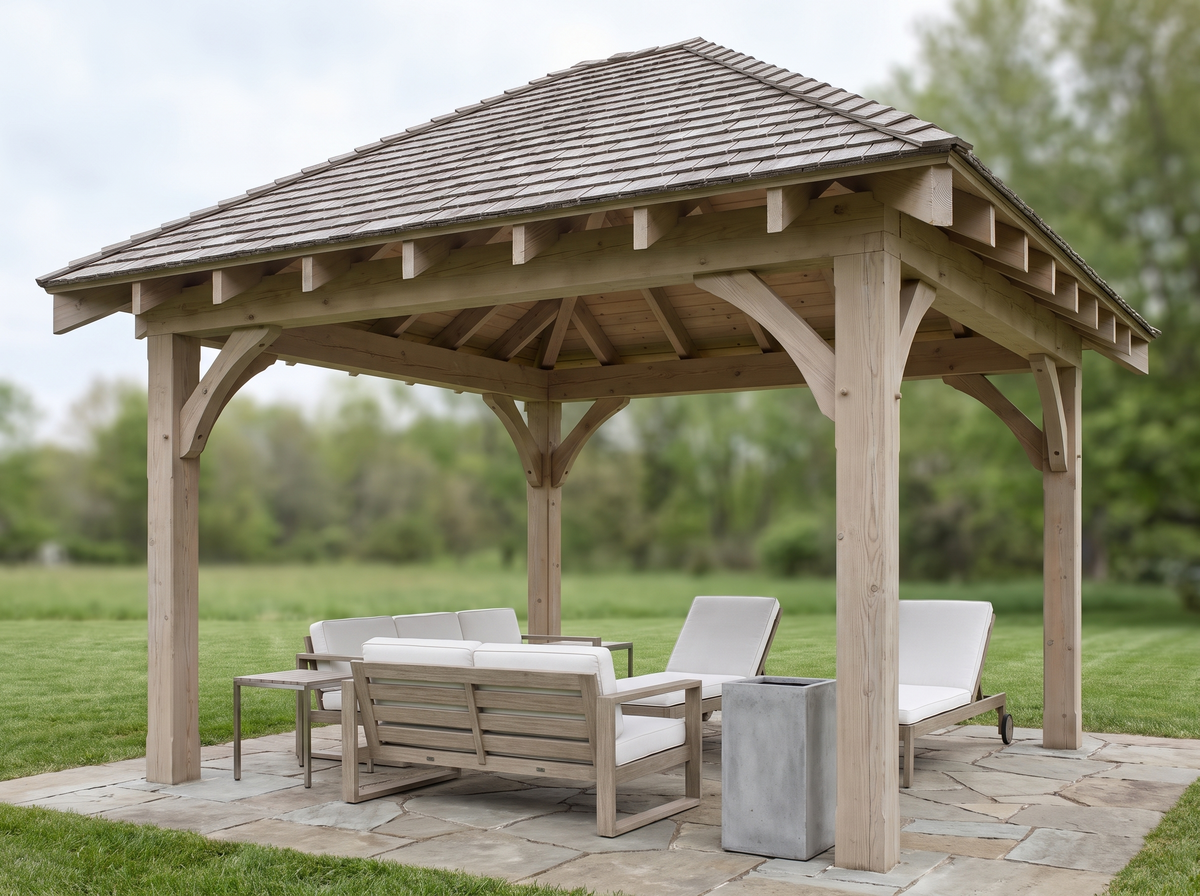
A custom gazebo in Utah runs about $22,000 to $48,000 installed, while a cedar kit costs about $1,800 in the box and about $5,000 professionally assembled. That gap is not markup. A custom gazebo carries an engineered roof on real footings, and in a snow state the roof is where the money goes. This guide separates the three things people call a gazebo so you can read any number you find.
Key takeaways
- This guide covers what a gazebo costs in Utah in 2026: the three products the word covers, real published kit prices, a custom range by dimension, why a gazebo costs more than a pergola, and a checklist for reading any builder's quote. Related: what a custom pergola costs in Utah, Utah pergola and pavilion permits, and can a pergola or pavilion handle Utah snow.
- A cedar gazebo kit costs about $1,800 for a 12x14 at Costco. Professionally assembled, about $5,000 for a 12x16 at Home Depot. Both are real published prices, not estimates.
- A custom gazebo built for your yard runs about $22,000 to $48,000, and the spread is size, roof, and site, not trim.
- Ignore cost-per-square-foot for gazebos. The published $60 to $100 band sits in a dead zone between the two products people actually buy. The arithmetic is in the second section.
- A gazebo costs more than a pergola because it has a real roof. A pergola's slatted top lets most snow fall through. A gazebo roof catches all of it, which pulls engineering and deeper footings in behind it.
- An octagon costs 15 to 25 percent more than a rectangle of the same footprint, because every cut is a compound angle and the roof has eight planes instead of four.
- Two quotes can differ by thousands on footings alone. Utah's code sets a 12 inch minimum and exempts a normal backyard gazebo from frost protection entirely, so ask any builder for a depth in inches.
- Stillbury builds open gazebos. No screens, no walls, no wired outlets, fans, or heaters. Lighting is string lights. If you want a screened room, hire someone who builds screened rooms.
How much does a gazebo cost in Utah?
A gazebo in Utah costs anywhere from about $1,800 to $48,000, and the reason that range is useless on its own is that "gazebo" describes three different products. Sorting them is the whole job of this guide.
| What you are actually buying | Typical installed price | What it is |
|---|---|---|
| Kit in a box | $1,800 to $2,400 | A fixed catalog size in pre-cut cedar with an aluminum roof. You assemble it. |
| Kit, professionally assembled | $4,900 to $5,100 | The same box, delivered and put up by the retailer's installer on a surface you already have. |
| Custom built for your yard | $22,000 to $48,000 | A structure designed for your site, with an engineered roof on footings below frost depth. |
Kit prices are published retail, checked 28 September 2026: Costco lists the Yardistry 12x14 wood gazebo with an aluminum roof at $1,799.99 and the Contemporary version at $2,399.99. Home Depot lists the Yardistry Meridian 12x16 cedar gazebo, professionally assembled, at $4,998.
Those three rows are not the same structure at three prices. They are three structures, and the third one is the only one that gets designed around your yard.
Why does the internet say $7,590 and a Utah builder say $30,000?
Because the cost-per-square-foot model that the whole category runs on does not survive contact with either end of the market.
Almost every gazebo cost guide prices the category the same way. Lawn Love, updated December 2025, puts a national gazebo installation at an average of $7,590, a typical range of $5,365 to $9,025, and $70 to $100 per square foot. HomeGuide's 2026 figures put a custom build at $8,600 to $14,400 for a 12x12 and $60 to $100 per square foot. Homewyse, in May 2026, lists $60.29 to $89.50 per square foot to install a wood gazebo.
Now run that model against two prices you can look up today.
Check it at the bottom. Home Depot's professionally assembled 12x16 cedar gazebo lists at $4,998, and has recently been discounted to $4,397. A 12 by 16 footprint is 192 square feet. At the full list price that works out to $26 per square foot, delivered and standing, and on the discount it is closer to $23. Either figure is less than half the bottom of every published band.
Check it at the top. Amish Country Gazebos, which ships into Utah, publishes that its gazebos start at $5,000 and average about $30,000. On that same 12x16 footprint, $30,000 is $156 per square foot, well above the top of every published band.
So the $60 to $100 figure does not describe the cheap product and does not describe the expensive one. It describes a gazebo in between, which is mostly a statistical artifact of averaging two different markets together. A per-square-foot number is a fine sanity check inside one tier. Across tiers it is arithmetic with no subject.
Cost per square foot tells you what a gazebo costs the way cost per pound tells you what a car costs.
The honest way to read a gazebo number is to ask what the roof has to do and what is holding it up. Everything else is detail.
What does a gazebo kit actually cost, in the box and installed?
Any guide that opens by telling you kits are junk is selling you something. The Yardistry gazebos at Costco carry a 4.8 out of 5 rating across more than 1,500 reviews, they are built from FSC-certified cedar with an aluminum roof, and they arrive pre-cut, pre-drilled, and pre-stained. For a flat patio and a modest footprint, a kit is a genuinely good purchase.
| Product | Published price | Size | Note |
|---|---|---|---|
| Yardistry wood gazebo, aluminum roof (Costco) | $1,799.99 | 12x14 | DIY assembly, FSC cedar, mocha stain |
| Yardistry Contemporary gazebo (Costco) | $2,399.99 | 12x14 | Steel roof trusses |
| Yardistry Meridian, professionally assembled (Home Depot) | $4,998 list, seen at $4,397 on promotion | 12x16 | Delivered and installed, three to six week lead |
| Yardistry Meridian with 12 ft privacy wall, assembled (Home Depot) | $5,056 | 12x16 | Same, plus one wall panel |
The number most cost guides never print is the gap between the first row and the third: about $3,200 to have someone else put it up. Lawn Love puts prefab installation labor at $500 to $1,500 on its own, which is closer to what an independent handyman charges than what the retailer's installed program costs.
If you are weighing a kit seriously, two sibling guides go deeper than this one does: what actually ships in a big-box kit covers the box contents, the post-to-post footprint, assembly hours, anchoring, and the warranty terms, and how long a wood structure really lasts covers what a kit's lifespan looks like in Utah.
One clarification, because the word "kit" does double duty. The kits above are third-party retail products. Stillbury also ships its own pre-cut kits nationwide, which are a different thing built from different material. Do not read the Costco numbers as ours.
What does a custom gazebo cost by size? (12x12, 12x14, 12x16)
A custom gazebo is priced by what its roof spans, not by its floor area. The kit market has settled on 12x14 and 12x16, which makes those the sizes worth comparing.
| Size | Kit, assembled | Custom built | What changes |
|---|---|---|---|
| 12x12 | Roughly $4,500 | $22,000 to $28,000 | Smallest practical hipped roof. Often stays under the 200 square foot permit line. |
| 12x14 | About $4,800 | $25,000 to $33,000 | Comfortably seats eight. Crosses 200 square feet at 168, so still under. |
| 12x16 | $4,998 list | $29,000 to $38,000 | 192 square feet. Fits a dining table and a seating group. |
| 16x20 | Not offered | $38,000 to $48,000 | Longer spans, bigger members, engineering almost certain. |
A number in a table is not a quote, and no builder can give you a firm one from a photograph. What moves your figure is the span, the roof assembly, how deep the footings have to go, how hard the site is to reach, and the finish. If you want to see your actual size standing on your actual patio before anyone talks money, that is what the free 3D design and written quote are for.
Why does a gazebo cost more than a pergola?
A gazebo costs more than a pergola of the same footprint because a gazebo has a roof and a pergola does not.
That sounds obvious and it is still the answer people skip. A pergola's top is a set of rafters with planks laid across them, open to the sky. A gazebo's top is a hipped roof: four planes rising to a peak, framed with hip rafters that meet in compound joints at every corner, sheathed, underlaid, roofed, and finished with fascia and deep overhangs. That is a roof in every sense a builder means it, and it brings along everything a roof brings. More material overhead means bigger posts and beams beneath it, and bigger members mean bigger footings.
The joinery is where the price difference becomes visible rather than theoretical. A kit corner is two boards and a bracket. A custom corner is cut to fit, seated, and pinned so the joint carries load instead of the fastener carrying it. That is slower work, and it is most of the difference between a structure that stays square for decades and one that starts to rack.
For what a pergola itself costs, the Utah pergola cost guide has the full breakdown by dimension. If you are still deciding which structure you want at all, pergola, pavilion, or cabana walks the choice.
What makes a gazebo cost more in Utah?
Snow, and specifically the fact that a gazebo roof catches it.
A pergola's slatted top lets most of a snowfall pass through the gaps. A solid roof holds every bit of it, and in Utah that is a real load: Provo's published ground snow load is 31 pounds per square foot, and mountain cities run several times higher. The Utah snow load guide has the figures for 27 cities and the rule that decides when an engineer's stamp is required.
Here is the part that shows up on your invoice. Utah cities generally ask for engineering calculations once a structure has a solid roof, because a solid roof is no longer something a reviewer can check against a standard table. So a gazebo, almost by definition, lands in the bracket where an engineer gets involved. That means a design fee, heavier members sized to the calculation, and footings poured below frost depth rather than a pad set on grade.
That is a budgetable line, not a scare. It is also the single reason a Utah gazebo quote reads higher than a national calculator: the calculator is pricing a structure that never had to hold anything up.
Whether you need a permit at all is a separate question with its own answer, and the Utah permit guide covers the under-200-square-foot rule, the attached versus detached distinction, and who is responsible for filing. Stillbury prepares the submittal for its own projects.
Why do two gazebo quotes differ by thousands? Look at the footings
Because Utah's building code lets a gazebo sit far shallower than most people assume, and not every builder tells you which choice they made.
Utah adopts the International Residential Code, and the 2021 edition it now uses sets the floor in section R403.1.4: exterior footings shall be placed not less than 12 inches below the undisturbed ground surface. Section R403.1.4.1 then requires frost protection, with exceptions. The first exception reads: *"Protection of free-standing accessory structures with an area of 600 square feet or less, of light-frame construction, with an eave height of 10 feet or less shall not be required."* The second exception grants the same relief at 400 square feet for structures that are not light-frame.
A 12x16 gazebo is 192 square feet. Freestanding, with an eave under 10 feet, it clears both thresholds comfortably. So a builder can legally set your gazebo on 12 inch footings and never approach the frost line.
That is not a loophole and it is not fraud. It is a code exception written for small, light accessory structures, and it is one of the reasons two quotes for the same gazebo can differ by several thousand dollars while both describe "footings."
Stillbury goes below frost depth anyway. The exception governs what a city will approve, not what stays square in year eight. A footing that stops above the frost line lifts each winter and settles each spring, the joints work loose a little on every cycle, and the structure starts to rack. How long a wood structure really lasts explains that mechanism in full, and Provo's published frost line depth is 30 inches.
Which makes this a question worth asking out loud. When you hold two quotes, ask each builder for a footing depth in inches. If one says 30 and the other says 12, you have found a real part of the price difference, and you can decide whether it is a saving or a deferral.
Does the shape change the price? Octagon versus rectangle
Yes. An octagonal gazebo runs about 15 to 25 percent more than a rectangular one covering the same ground, and the reason is entirely in the cutting.
| Factor | Rectangular gazebo | Octagonal gazebo |
|---|---|---|
| Posts | 4 | 8 |
| Roof planes | 4 | 8 |
| Corner cuts | Square and repeatable | Compound angles, every one |
| Roofing waste | Low | High, every plane is a triangle |
| Typical premium | Baseline | 15 to 25 percent |
| Best for | Dining, seating groups, a hot tub | A garden focal point, a view in every direction |
A rectangle is the economical shape because a builder can cut four of everything and they are all the same. An octagon needs eight compound cuts per ring, an eight-way crown where the hips meet, and roofing cut to eight planes with more offcut than a four-sided roof produces. None of that is difficult work. It is just more of it, done slower.
Stillbury's Rustic gazebo is the four-sided hipped form with curved corbel braces and deep overhangs in natural Douglas fir, and a two-slope gable version is available when the site calls for it. Which shape suits your yard is a design question rather than a budget one.
What is not in the price (and what we do not build)
Most gazebo quotes cover the structure. Several things people assume are included are not.
| Item | Typical cost | Note |
|---|---|---|
| Concrete slab | $5 to $10 per square foot | A 12x16 slab is roughly $960 to $1,920 |
| Footings | $500 to $2,500 | Depth is a choice with a code floor, and it is where quotes quietly differ. See the section above. |
| Screening, professionally installed | $2,000 to $4,000 | Varies with panel count |
| Screen kit, do-it-yourself | $250 to $800 | Retail kits for existing gazebos |
| Flooring upgrade | $7 to $15 per square foot | Above a plain slab |
| Permit fee | Usually under $500 | Set by your city |
Now the honest part, because a lot of people searching "gazebo cost" have a screened hardtop in mind.
Stillbury builds open gazebos. A hipped roof, real posts, and air on all four sides. We do not build screened rooms, we do not enclose them, and we do not run wired power: no outlets, no ceiling fans, no heaters. Lighting is string lights. If the structure you actually want is a screened, powered garden room, the numbers above will get you started but you want a different contractor, and we will tell you that on the call rather than after the deposit.
We also have not finished a gazebo for a Utah homeowner yet, so there is no project photograph in this guide and no "here is what the Johnsons paid." What we can show you is the arithmetic, the published prices, and the code trigger that decides whether your roof needs an engineer. That is checkable, which is more than a testimonial gives you.
What should be in a gazebo quote?
A written quote should let you compare two builders without phoning either of them. Ask any company quoting you for these seven things.
- Dimensions stated both ways. Roof-to-roof and post-to-post. A "12x16" can mean either, and the difference is real floor space.
- The roof assembly, named. Framing, sheathing, underlayment, and the roofing product. "Metal roof" is not a specification.
- Footing type and depth, in inches. The code floor is 12 inches and a normal backyard gazebo is exempt from frost protection, so "footings included" tells you nothing. Get the number.
- Who carries permit and engineering responsibility. In writing. If the answer is "you pull it," that is a cost and a schedule risk that just moved onto you.
- The finish and its reapplication interval. What is on the wood, and when it needs doing again.
- The warranty term. Stillbury's is three years on the structure. Whatever the number is, get it on paper.
- What is excluded. Slab, grading, electrical, landscaping repair.
A quote that answers all seven is comparable to another quote that answers all seven. A quote that answers three is a number with no subject. Those seven specify the structure. For the paperwork half, including the licence classification that may legally build one and the three conditions that keep a supplier's lien off your house, see how to choose a pergola builder in Utah.
Kit or custom: which is right for you?
| Factor | Kit, self-assembled | Kit, professionally assembled | Custom built |
|---|---|---|---|
| Price | $1,800 to $2,400 | About $5,000 | $22,000 to $48,000 |
| Sizes | Fixed catalog, mostly 12x14 and 12x16 | Same fixed catalog | Any size your yard takes |
| Timeline | A weekend, with help | Three to six weeks | Weeks of design and build |
| Roof | Aluminum panel | Aluminum panel | Engineered, any assembly |
| Footings | Usually anchored to an existing surface | Usually anchored to an existing surface | Poured below frost depth |
| Snow engineering | Not provided | Not provided | Calculated for your address |
| Permit path | Simplest, especially under 200 square feet | Simplest | More likely required, and handled for you |
| Fit to the house | Nearest catalog match | Nearest catalog match | Designed to the house and the sight lines |
| Best for | A flat patio, a modest budget, a weekend | Wanting the kit without the weekend | A structure meant to outlast the mortgage |
The kit wins on price, on speed, and on permit simplicity, and those are not small wins. If your patio is flat, your footprint is modest, and you want shade this month, buy the kit. We will say that on the phone.
Custom is the answer when the size you need is not in the catalog, when the roof has to carry real snow, or when the structure has to look like it belongs to the house rather than like it arrived on a pallet. A kit seller offers you the nearest standard size to your space. A custom builder designs to the space itself, which is why Stillbury shows you the finished structure in 3D, on your own patio, with a written itemised quote, before you have paid anything.
Reading any gazebo number
The three prices in this guide are all real and all correct, and they describe three different things. A kit is a product. An installed kit is a product plus labor. A custom gazebo is a designed structure with an engineered roof on footings, and in Utah that roof is not decoration. It is the part that holds up the snow.
So when a number surprises you, in either direction, ask the same question: what does the roof have to do, and what is holding it up? That answer explains nearly every gazebo quote you will ever read.
If you want to see what your yard actually takes, a free 3D design and a written quote will show you the real structure at the real size before you spend anything.